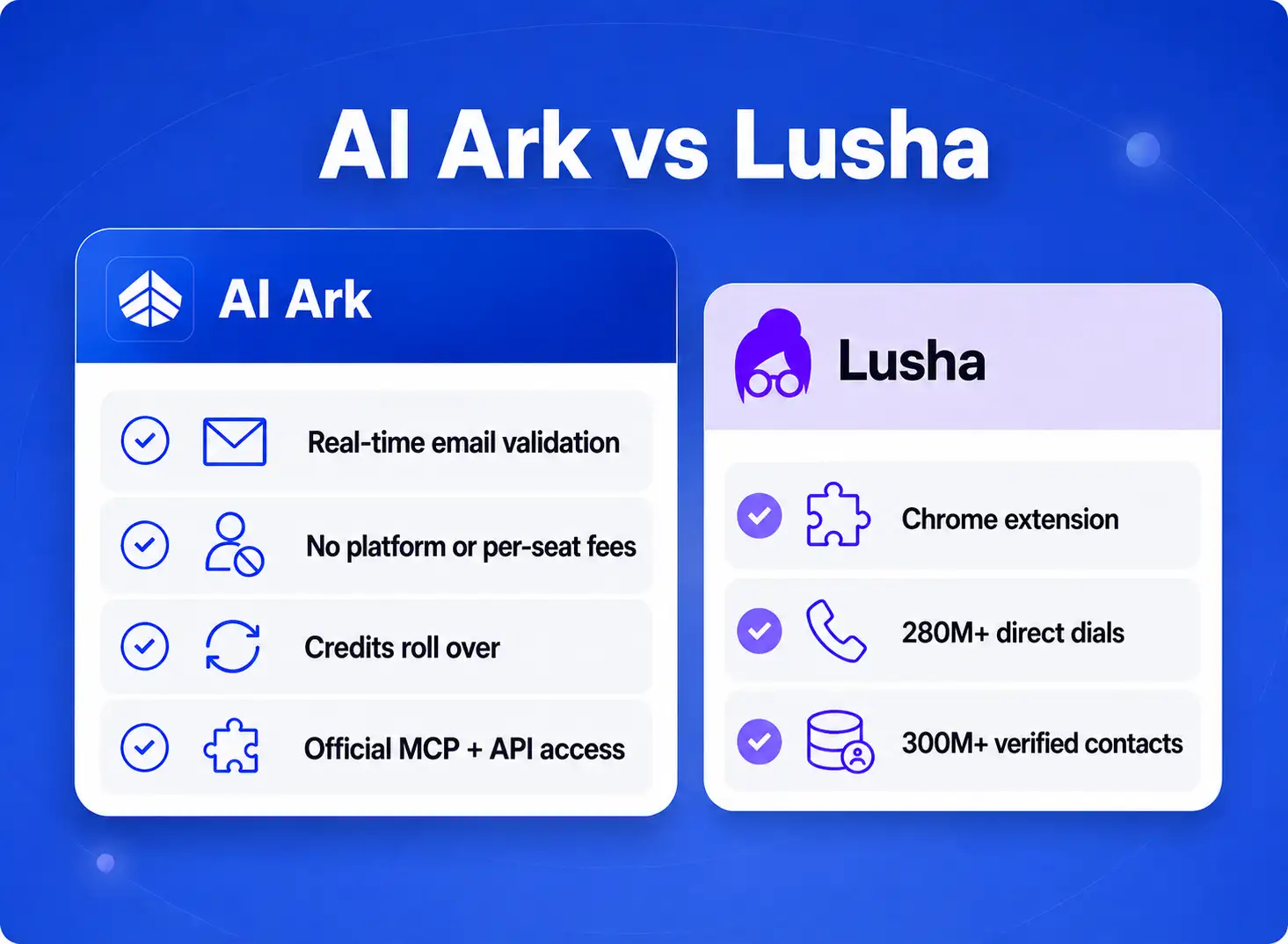
Pick AI Ark if you build large verified lists and export them into your own sending stack. Every email is checked at export, and one file holds up to 10,000 records. Pick Lusha if reps reveal contacts one at a time inside LinkedIn and the CRM. AI Ark is the higher-volume Lusha alternative.
Last updated: September 2026
Key takeaways
Different unit of work. AI Ark is built around the export: filter, select up to 10,000 records, download a file. A Lusha CSV export from search covers 150 contacts.
Different point of validation. AI Ark verifies each email at export and delivers only what passed. Lusha verifies earlier and shows an A+ or A rating, so you decide.
Refresh cadence. AI Ark rebuilds its whole database every 30 days. Lusha refreshes most fields weekly.
Credit units differ. AI Ark charges 0.5 credits per person record and 0.5 more only when a valid email is found. Lusha charges 1 per email and 5 per phone.
Rollover differs annually. AI Ark lets unused credits build to twice your plan limit. Lusha grants the annual pool upfront and resets the unused balance at cycle end.
Ask AI about this comparison




AI Ark vs Lusha at a glance
Feature | AI Ark | Lusha |
Category | Prospect and company discovery database with bulk export | Contact data platform with built-in outreach |
Database size | 400M+ people, 70M+ companies | 290M+ contacts, 29M+ companies |
Database refresh | Entire database rebuilt every 30 days | Weekly on most fields |
Email validation | Real-time BounceBan check at export; only addresses that passed are written to the file | Verified in advance, surfaced as a confidence rating |
Published accuracy | Only addresses that passed verification are delivered; bounce rate under 1.5% expected | 98% email accuracy |
Catch-all addresses | Validated individually; confirmed catch-alls are delivered, risky and unknown ones filtered out | Not addressed in published documentation |
Pricing model | Credit packages, monthly or annual, credits pooled across the team | Per-seat plans with an included credit allocation |
Published entry price | 5,000 credits for $49/month; 60,000 credits for $470/year | Starter $49.90/month, or $37.45/month billed annually |
Credit rollover | Yes, up to 2x your plan limit | Monthly plans yes; annual plans reset at cycle end |
Free tier | Yes, 100 credits per month | Yes, 40 credits per month |
Export ceiling, one file | 10,000 records per batch, repeatable with the Net New filter | 150 contacts per CSV selection |
Duplicate protection | Net New vs Saved Records; an exported contact is never charged twice in the AI Ark app | Re-viewing a revealed contact costs 0 credits |
Native CRM sync | API plus Zapier, Make, n8n and Clay | Yes |
API and MCP server | Both; API priced identically to in-app exports, 300 requests per minute on standard plans | Both; API from the Pro plan |
What Teams Say About AI Ark


What is AI Ark?
AI Ark is a B2B prospect and company discovery database, built for teams whose week is measured in lists: agencies running outbound for several clients, SDR teams refilling a sequence every Monday, RevOps rebuilding a territory file, recruiters mapping a talent pool. It covers over 400 million people and 70 million companies, and we rebuild all of it every 30 days.
We assume you already own your outreach stack: a sender, a CRM, a sequencer you have paid for and configured. AI Ark's job is not to replace that. It is to hand you a file that drops straight into what you run, with every email checked at export so you are not paying a verification tool to clean it afterwards.
The filters are where the product spends its effort. Company Lookalike takes up to five seed URLs and matches on what a company actually does, reading its description, products and keywords rather than headcount and industry codes. Net New vs Saved Records tracks what you have already pulled, so you never buy the same contact twice. Several filters here are ones most databases skip: headcount growth above a set percentage over 6 months, 1 year or 2 years; employees by department; time in role separate from time at company, which isolates internal promotions; and company HQ separate from the person's own location.
What is Lusha?
Lusha is a B2B contact data platform, and its core use is fast: a rep on a LinkedIn profile, a Sales Navigator list or a company website clicks the browser extension and gets a work email and a direct dial. Around that sit a prospecting search with firmographic filters, a Workspace where AI builds tables from a plain-language description, an Enrich page for filling gaps in an uploaded CSV, Engage for sending sequences from Gmail or Outlook, and Conversations, which records and transcribes calls at 8 credits each. There are native integrations with Salesforce, HubSpot, Pipedrive and Bullhorn, an API from the Pro plan, an MCP server, lookalikes, and 26 signals covering funding, hiring surges and job changes. The database holds over 290 million contacts and 29 million companies, used by more than 280,000 revenue teams.
The data comes from a vetted contributor network alongside professional communities and partner vendors, and Lusha states it does not scrape professional networks or buy from third-party data brokers. Records are deduplicated automatically and most fields refresh weekly. Verification happens before you see the record: each email carries an A+ or A rating, where A+ means highly likely to deliver and A a good likelihood with some accepted risk.
Pricing is public, which is uncommon in this category. Five plans run from a permanent free tier at 40 credits a month to a custom-quoted Scale plan, priced per seat with an included credit allocation. It suits a rep or small team working account by account, where the value is a good number in ten seconds.
See how AI Ark handles your ICP.
Free tier, 100 credits a month, no card and no time limit.
Data quality: where validation happens
Both verify emails. The difference is when, and who holds the risk.
How AI Ark does it
We verify every email with BounceBan at the moment you export, not when the record entered the database. Catch-all domains are checked individually: where we can confirm a specific address on one is live, we mark it Catch-All Valid and include it. Where we cannot, it is not in the file. Invalid, unknown and risky addresses are never delivered, which is why we expect a bounce rate under 1.5%, and why a verified export can take up to 30 minutes.
About 70% of records in a typical export come back with a valid email. That is the honest consequence of the design: verifying at export rather than shipping a stored status means we cannot tell you who has a live address until the check runs, which is also why you cannot pre-filter a search to people with emails. The other 30% still carry the LinkedIn URL, job title and company.
How Lusha does it
Lusha builds from a vetted contributor network, professional communities and partner vendors, then validates automatically. Its published figures are 98% email accuracy and 86% phone accuracy. Rather than filtering on your behalf it hands you the judgement: every address carries an A+ or A rating, and the docs are direct that A means some risk of non-delivery is acceptable. You can also filter by Has email or Has phone before spending anything.
Third-party evidence is mixed rather than damning. On G2, Lusha holds 4.3 out of 5 across 1,668 reviews as of 4 September 2026, and positive accuracy themes outnumber negative ones by a clear margin. Among the negative themes, one group of 30 reviews describes roughly 15 to 20% of contacts being incorrect or missing details. A GTM manager reviewing on 1 May 2026 reported repeated bounces; Lusha's reply cited 9 million newly verified work emails.
The trade-off, stated fairly
Lusha's model gives you two things AI Ark does not. Results are instant, because nothing is checked while you wait, and you see the confidence rating and availability filters before committing a credit.
AI Ark's model moves that work to us. You wait longer on a large export, in exchange for a file that loads into a sender with nothing in between. Either way the test is free: export the same 500 contacts from both and compare the bounce reports.
True cost: what a valid lead actually costs
List price tells you little here, because the two platforms sell different units. A Lusha credit buys one revealed email; an AI Ark credit is a half-unit buying either a profile or a validated email. The only figure that travels between them is annual spend divided by valid contacts delivered.
Published pricing
Lusha
Plan | Monthly | Billed annually | Credits | Seats |
Free | $0 | $0 | 40/month | 1 |
Starter | $49.90 | $37.45/month | 4,800/year | 1 |
Pro | $69.90 | $52.45/month | 7,200/year | 2 |
Premium | $399.90 | $299.95/month | 40,800/year | 5 |
Scale | Not publicly stated | Not publicly stated | Custom | Custom |
AI Ark
Plan | Credits per month | Monthly billing | Annual billing (credits per year) | Seats included |
Free | 100 | $0 | $0 | 1 |
Starter | 5,000 to 30,000 | $49 to $119 | $470 for 60,000 to $1,142 for 360,000 | Up to 3 |
Builder | 60,000 to 300,000 | $219 to $879 | $2,102 for 720,000 to $8,438 for 3,600,000 | Up to 5 |
Scale (Agency & Enterprise) | 450,000 to 5,000,000 | $1,249 to $9,999 | $11,990 for 5,400,000 to $95,990 for 60,000,000 | 10 |
On AI Ark, a person record costs 0.5 credits, a valid email adds 0.5, a mobile number is 5 and a company record 0.1. On Lusha, an email reveal is 1 credit, a phone 5, both up to 6, a matched CSV row 1 and a recorded call 8, while searching and filtering are free.
A worked example
Take a team needing 3,400 verified contacts a month, 40,800 a year, with its own sending tool.
On Lusha, the cheapest published plan covering 40,800 email reveals is Premium at $299.95 a month billed annually: $3,599.40 a year for 40,800 credits and five seats. Applying Lusha's own 98% email accuracy gives roughly 39,980 deliverable contacts, or $90 per 1,000 valid contacts.
On AI Ark, reaching about 40,000 valid emails at our 70% find rate means exporting roughly 57,150 records: 28,575 credits for profiles plus 20,000 for emails, around 48,600 total. The cheapest annual package covering that is 60,000 credits at $470, or $11.75 per 1,000 valid contacts. The 17,000 or so profiles without an email still arrive with LinkedIn URLs and job titles.
The counterpoint, stated honestly
That $3,599 is not buying data alone. It covers five seats, the extension, sequences, native Salesforce and HubSpot sync, 26 signals and call recording. With no outbound stack yet, weigh it against the whole set of tools you would otherwise buy, not against AI Ark alone.
The line item missing from both pricing pages is verification. A stored confidence rating describes what was true when the record was collected, not on send day, so teams buying by the thousand usually run lists through MillionVerifier or ZeroBounce first and pay for the rows they throw away. AI Ark folds that step into the export price, which is most of why the two figures diverge.
Work out your own number.
Compare pooled credits and 10,000-record exports against what per-seat licensing costs you today.
Features side by side: how AI Ark works as a Lusha alternative
Finding the right accounts
Feature | AI Ark | Lusha |
Company search with firmographic filters | Industry, location, annual revenue, employee size by actual headcount rather than self-reported range | Yes |
AI Lookalike, semantic company matching | Up to 5 seed URLs; matches on company description, SEO description, products and services, and keywords, with your filters layered on top | Yes, attribute-based |
Headcount growth filter | Minimum growth percentage over 6 months, 1 year or 2 years | Yes, as a signal |
Employees by department | Yes, filter on department size, for example large engineering beside small sales | Yes |
Technographics | Yes | Yes |
Funding | Yes | Yes |
AI Ark's strength is account shape: growth and department structure are filters, not alerts.
Finding the right people
Feature | AI Ark | Lusha |
Job title, seniority, function | Organization Role filter for C-Suite, VP or Director, refined by function within a department | Yes |
Person location separate from company HQ | Yes, applied independently, plus states, cities, continents and world regions | Yes |
Time in role vs time at company | Two separate filters; short time in role plus long tenure isolates internal promotions | No |
Keyword search scoped to a profile section | Yes, restrict a keyword to Headline, Summary or Skills only | No |
Match modes | Smart, Word and Strict, from AI-expanded synonyms to exact characters | No |
Profile badges | Include Premium members, include or exclude Open to Work | No |
Economic zone filters | Yes, G7, G20, European Union | No |
Batch title paste | Up to 300 comma-separated terms into Job Role, Industry or Keywords | Yes |
Max people per company | Yes, cap the number selected per organisation before export | No |
Getting data out and using it
Feature | AI Ark | Lusha |
Bulk export ceiling | 10,000 records per batch; repeat with the Net New filter until the count reaches zero | 150 contacts per CSV selection |
Custom export templates | Yes, drag-and-drop column selection, saved and reusable | No |
Duplicate protection | Net New vs Saved Records tracked account-wide; exported contacts are never re-charged in the AI Ark app | Yes |
Bulk input search | Paste or upload up to 10,000 domains or LinkedIn URLs, then pull every employee at those companies | Limited |
API access | Yes, same credit pricing as in-app exports, 300 requests per minute on standard plans | Yes |
MCP server | Yes, works in Cursor, Claude and Windsurf | Yes |
Clay, n8n, Make, Zapier | Yes, via API, with published Clay templates | Yes |
Native CRM sync | export to CSV or push via API | Yes |
The export ceiling is the widest gap here, and it decides more evaluations than anything else.
Compliance and data sourcing
We're a B2B search engine and data provider. We aggregate from public sources, community contributions and partner networks, then run validation algorithms to clean the result. For records in our own database we act as controller, processing on the basis of legitimate interests under GDPR Article 6(1)(f) for B2B purposes, and we adhere to GDPR and CCPA. When you upload a CSV for enrichment or exclusion, we process it as processor on your behalf.
Our terms prohibit automated extraction, scraping and abusive access, and accounts showing robotic search velocity are restricted for 24 hours and flagged to security.
Lusha holds ISO 27001 and ISO 27701 certification, a SOC 2 Type II report and independent TRUSTe verification for Responsible AI, alongside GDPR and CCPA compliance, and runs a public Trust Center with a removal request form.
Choose Lusha if
Your reps prospect inside LinkedIn, Sales Navigator or company websites and want details revealed in the tab they are already in.
You need contacts written straight into Salesforce, HubSpot, Pipedrive or Bullhorn, with no CSV step.
You want one subscription covering data, sequences and call recording rather than a stack.
You want a confidence rating and Has email or Has phone filters before spending a credit.
Direct dials are central to your motion and you would rather pay 5 credits in the same tool than source numbers separately.
You are a solo seller or small team where one seat covers everything and volume stays in the hundreds.
Funding rounds, hiring surges and job changes drive your timing.
Choose AI Ark if
You build lists in the thousands and need them out in one file, not selections of 150.
You already own your sender, whether Smartlead, Instantly or Email Bison, and want data that loads in without a verification pass first.
You are tired of paying MillionVerifier or ZeroBounce to clean a list you have already bought.
Your targeting depends on filters most databases skip: headcount growth, department size, time in role against time at company, or person location separate from company HQ.
Catch-all domains are a real share of your market and you would rather have the validated ones than lose them all as risky.
You run outbound for several clients and need pooled credits, shared lists, unbranded CSVs and duplicate protection.
Cost per valid contact at volume is the number your budget is judged on.
If most of that is you, the fastest way to settle it is one real ICP search through both, judged on what lands in your sender. We would rather you tested the file than took our word for it.
Frequently Asked Questions
1. Is AI Ark a direct replacement for Lusha?
For finding and exporting verified contacts, yes. For the rest, no. AI Ark has no browser extension, no native CRM sync and no sequencer, so if your reps reveal contacts on LinkedIn and push them into HubSpot without leaving the page, AI Ark alone would remove that. Teams already running a separate sender and CRM usually find the swap clean.
2. Is AI Ark's data more accurate than Lusha's?
They are measured differently, so a direct comparison misleads. AI Ark verifies every email at export and delivers only what passed, so the figure applies to the file you receive. Lusha publishes 98% email accuracy and marks each address A+ or A so you filter before sending. Export the same list from both and compare the bounce reports.
3. Do I still need a separate email verifier with AI Ark?
No. Every address is checked before the file is written, and invalid, unknown and risky ones are excluded rather than flagged, so the export goes straight into your sending tool. That is also why a verified export can take up to 30 minutes.
4. What happens with catch-all domains?
AI Ark validates catch-all addresses individually rather than dismissing them. Where we can confirm one is live it is marked Catch-All Valid and included; where we cannot, it is excluded. That matters in markets where many mid-market domains are catch-alls and most tools drop them as risky.
5. Which is cheaper, AI Ark or Lusha?
At volume, AI Ark. A team needing about 40,000 valid emails a year pays $470 on AI Ark, roughly $11.75 per 1,000 valid contacts. The same output on Lusha Premium costs $3,599.40 for 40,800 credits, about $90 per 1,000 at Lusha's published accuracy. Both figures are annual spend divided by valid contacts delivered.
6. Does AI Ark have intent data or a Chrome extension?
No to both. Lusha carries 26 signals including funding events, hiring surges and job changes, and its extension reveals contacts on LinkedIn and company sites. Our equivalent is filter-based: headcount growth thresholds, department size and time-in-role filters build the same list from search rather than alerts.
7. Can I use AI Ark inside Clay?
Yes. Our API works through Clay's HTTP Request module, and we publish Clay templates and a video walkthrough in the docs. The Export Single Person with Email endpoint handles row-by-row enrichment: pass a LinkedIn URL, get back a validated email plus profile data. n8n, Make and Zapier work the same way.
More Comparisons


Transform your
B2B data